

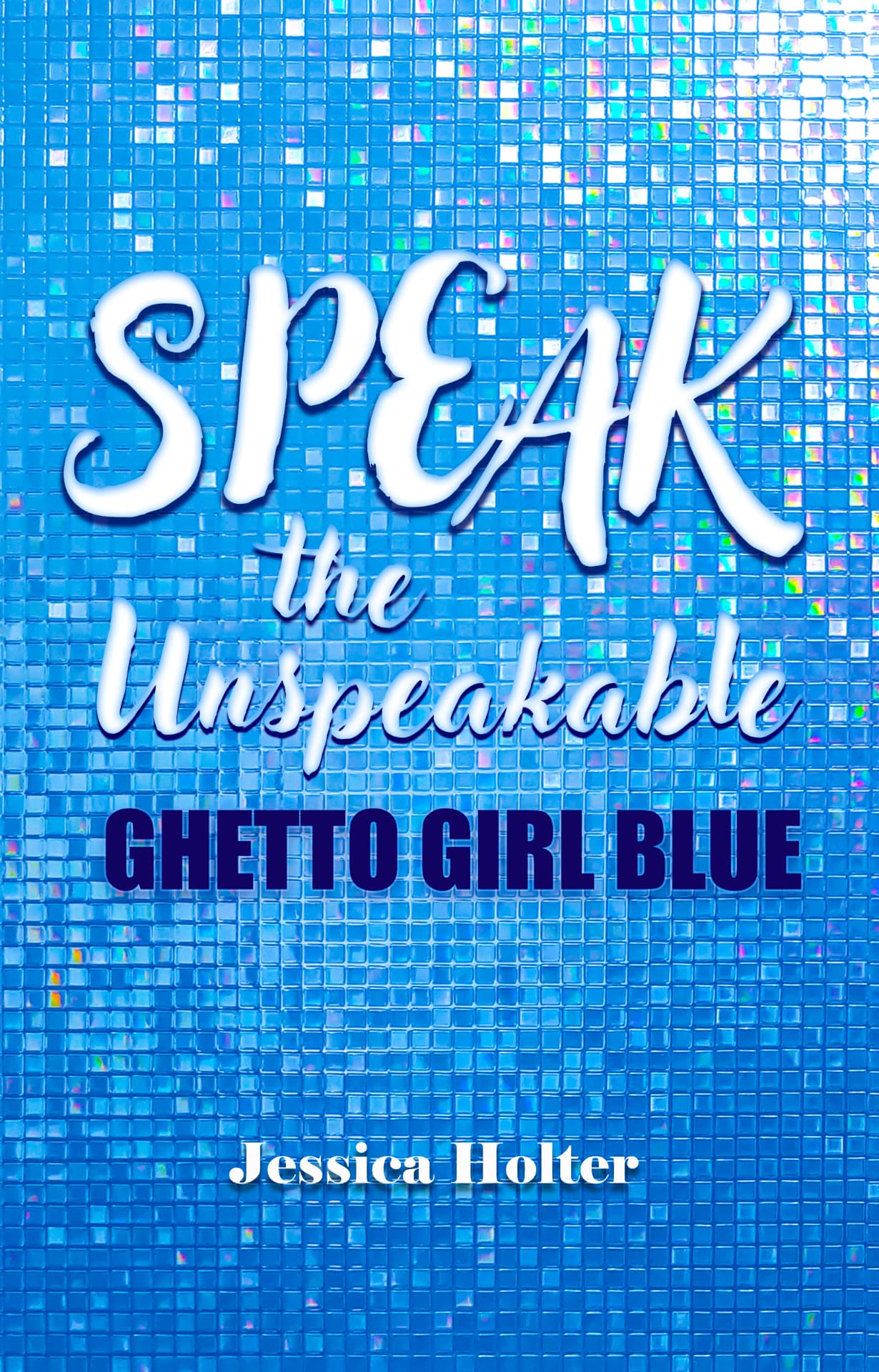
Speak the Unspeakable Ghetto Girl Blue
By Jessica Holter
- book
- poetry
- essays
- Voices of Foster Care
Pulling her famous red curls into a messy bun, Jessica Holter becomes Ghetto Girl Blue in the telling of her personal journey from hippie commune to the international stage of HBO’s Real Sex. In Speak the Unspeakable, she peels away layers of theatrical makeup and fishnet stockings to reveal a vulnerable yet resilient young woman coming of age in a complicated world. For readers who know Holter only as the founder of The Punany Poets, the acclaimed creator of romantic edutainment, or the outspoken voice who helped bring poetry, sexuality, and emotional literacy into public conversation, this book offers something more intimate. It is the story beneath the performance, the woman behind the microphone, and the lived experiences that transformed observation into art.
With trigger warnings in place, Holter invites readers on a brief, humorous, and emotionally charged journey through foster care, U.S. Army Basic Training, and her years at Howard University, when Washington, D.C., was still known as “Chocolate City.” She immerses us in the spirit of possibility as she searches for mentors and is offered pickles along the way. From the colorful streets of P Street to the down-low crevices of Tracks nightclub, Ghetto Girl Blue weaves a vivid tapestry of D.C. in its heyday.
Readers follow her onto trains and into erotic limo rides where romantic trysts unfold with a recurring lover, a permanently uncommitted fixture in her life. With shock and awe, she shares her plan for making something from nothing, never mincing words about what can happen when you cannot recognize a pimp and do not know how to say no.
Along her journey to the theatrical stage and the printed page, she falls in love with Hip Hop, journalism, interviews, and the people who shape her path. She shares spaces with the rich, the famous, and the intellectuals, all of whom play a role in her personal evolution and in the creation of The Punany Poets. What would eventually become a nationally recognized cultural movement begins here not as an institution, but as a collection of questions, risks, aspirations, and hard-earned lessons.
Speak the Unspeakable is also poetic evidence of Holter’s Christian foundation and the sexual trauma that placed a scarlet letter upon her chest. Her Black Church roots are essential to understanding the author, who was at various times a youth minister, a door-to-door evangelist, and the foster child of a deacon who molested her.
Born the biracial daughter of an Irish American mother and the twenty-third child of a rolling-stone father she never met, Holter carries readers into her twilight years, where the search for identity leads her to her blood family and, finally, to a sense of belonging.
Yet this memoir is more than a personal history. It is a reflection on survival, reinvention, and the ways people create themselves when the world offers few instructions and even fewer guarantees. The same imagination that would later produce books, stage productions, educational initiatives, and immersive story worlds is visible throughout these pages in its earliest form: a young woman determined to make meaning out of chaos and a future out of uncertainty.
Infused with exposés, essays, poetry, positive affirmations, and self-help anecdotes, Speak the Unspeakable speaks to people of color, women, the abandoned masses of foster children, and survivors of sexual abuse. It is a testament to survival, self-discovery, and the transformative power of telling what others would rather leave unsaid. Some stories entertain. Some stories educate. And some stories become evidence that a life, however complicated, can be reclaimed. Speak the Unspeakable is all three.